

 Deutsch

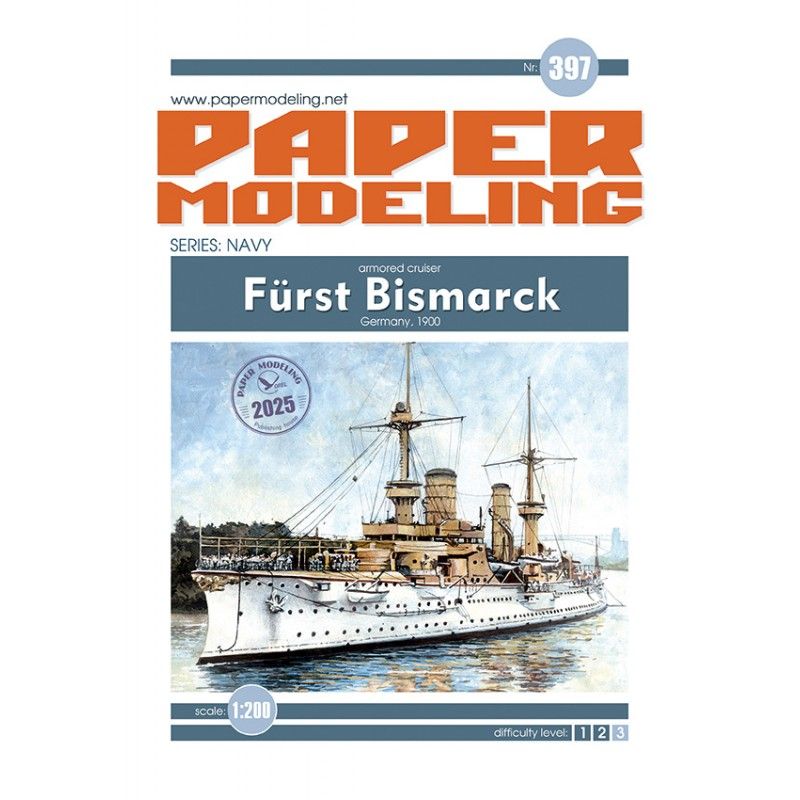


Armored Cruiser SMS Fürst Bismarck (1900)
Scale: 1/200
Skill Level: difficult
Size (LxW): 635x102 mm (25x4 inch)
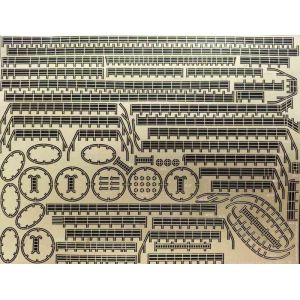
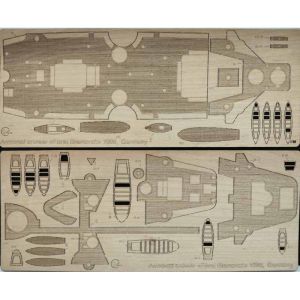

An exceptional masterpiece for collectors of Imperial German naval history: a highly detailed 1:200 scale reconstruction of the first German armored cruiser SMS Fürst Bismarck as configured in 1900. This advanced kit stands out with its high accuracy and the striking tropical white and yellow livery worn during her deployment in East Asia.
This kit is a premier highlight for enthusiasts of classic turn-of-the-century naval design. The engineering masterfully captures the vessel's imposing silhouette, defined by massive military masts, tall funnels, and characteristic hull contours. The graphic presentation offers crisp, clean detailing of the tropical white hull, yellow superstructure, and the ornate gold decorations at the bow and stern.
Intended for highly experienced modelers, the assembly features intricate sub-units including the main and secondary gun turrets, numerous ship boats with delicate davit arrangements, and complex deck fittings. Rigging the two large military masts requires patience and a steady hand. Designed as a full-hull model, the build is supported by comprehensive technical diagrams.
The model highlights:
- Distinctive Colonial Livery: The model is presented in the elegant white-and-yellow overseas color scheme of the East Asia Squadron.
- Detailed Ornamentation: High-quality print showcasing the intricate gold-colored bow and stern decorations of the historical cruiser.
Product Safety InformationImporteur EU: fentens productions, Fürstenbergstr. 19. D-49716 Meppen
| Product type | Papermodel |
|---|---|
| Manufacturer | Oriel |
| Scale | 1/200 |
| Difficulty | difficult |
| Sheet size | DIN A4 |
| Sheets | 28 |
| Length | 635 mm (25.0 inch) |
| Width | 102 mm (4.02 inch) |
| Bauanleitung | English, Russian, Pictures |
Technical data:
- Type: Armored Cruiser (Large Cruiser)
- Commissioned: 1900
- Displacement: approx. 11,460 tons (maximum load)
- Length Overall (LOA): 127.00 m
- Beam: 20.40 m
- Maximum Draft: 8.46 m
- Propulsion: 4 Thornycroft boilers, 8 cylindrical boilers, 3 vertical 4-cylinder triple-expansion steam engines, 3 shafts
- Power Output: approx. 13,500 ihp
- Top Speed: 18.7 knots
- Complement: approx. 620 crew
- Main Armament: 4 × 24.0 cm quick-firing guns in two twin turrets (bow and stern)
- Secondary Armament: 12 × 15.0 cm quick-firing guns in casemates and single turrets
- Auxiliary Armament: 10 × 8.8 cm quick-firing guns, smaller automatic cannons, 6 × 45.0 cm torpedo tubes
The SMS Fürst Bismarck was the first true armored cruiser (classified as a "Großer Kreuzer" or Large Cruiser under the German system) built for the Imperial German Navy. Laid down in 1896 at the Kaiserliche Werft in Kiel, she was launched in 1897 and commissioned in August 1900. Her design was largely derived from the contemporary Kaiser-Friedrich-III-class battleships, though she was lengthened, built for higher speeds, and carried lighter armor protection. She was designed as a unique, single-ship class intended specifically for colonial and overseas station service to project German power globally.
Immediately after completion, Fürst Bismarck was dispatched to East Asia to reinforce the Imperial East Asia Squadron. Upon arrival at the German concession of Tsingtau, she assumed the role of squadron flagship. During her years of service in East Asia, the cruiser was involved in operations related to the Boxer Rebellion and represented the German Empire in numerous diplomatic visits and port calls across China, Japan, and Russia. Throughout this overseas deployment, she wore the distinctive peacetime colonial livery of a white hull paired with yellow superstructures.
In 1909, the cruiser returned to Germany and underwent a thorough modernization at the Imperial Shipyard in Danzig. However, by the outbreak of World War I in August 1914, the vessel was obsolete. She was briefly reactivated for coastal defense but, due to inadequate armor and speed, did not participate in active front-line operations. From 1915 onward, she served as a floating office and training ship for stokers in Kiel. Following the end of the war, Fürst Bismarck was stricken from the naval register in 1919 and broken up for scrap in Rendsburg the following year.